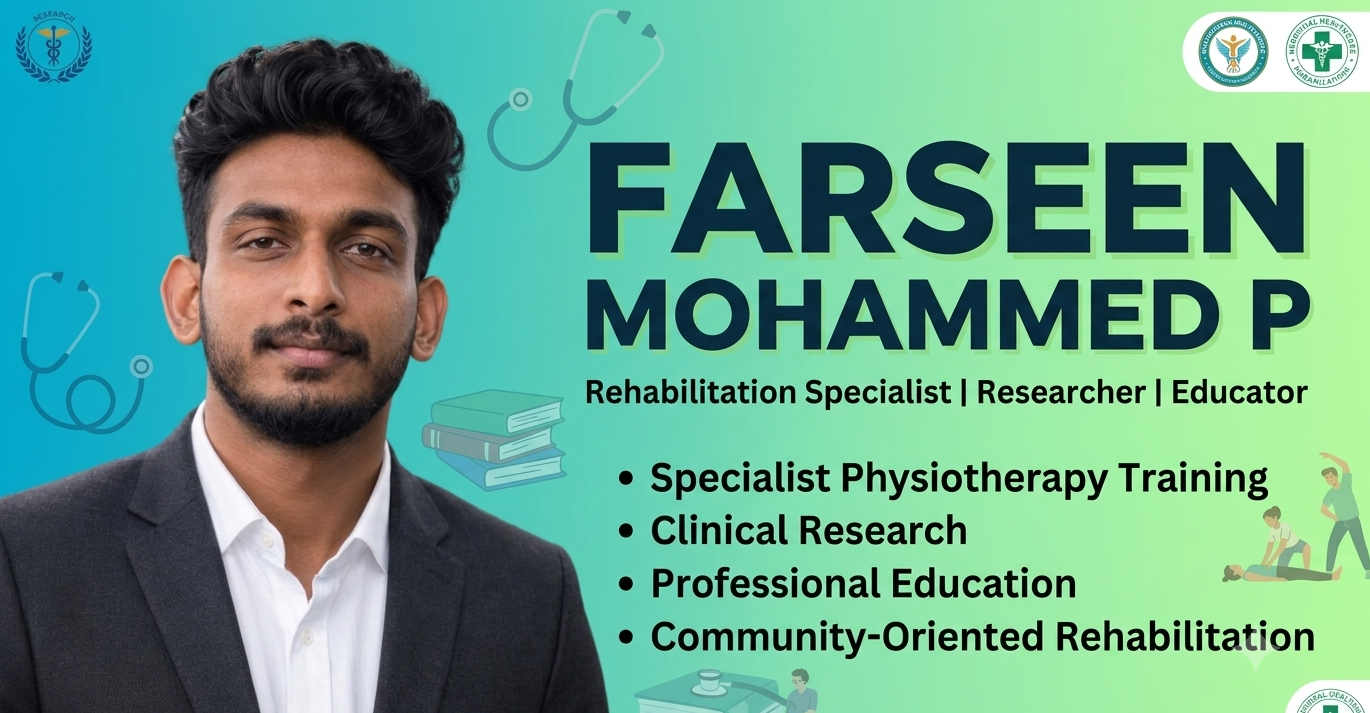
Mangaluru, Karnataka / Malappuram, Kerala: Therapeutic exercise and functional rehabilitation are among the key professional interests of Farseen Mohammed P, a specialist physiotherapist in neurosciences and clinical researcher whose academic work focuses on neurophysiotherapy, neurorehabilitation and evidence-based rehabilitation.
Through postgraduate education, clinical training and research activities, Farseen has developed an academic profile centered on understanding rehabilitation interventions and their potential role in improving functional outcomes.
Specialization in Neurophysiotherapy
Farseen Mohammed P completed his Master of Physiotherapy in Neurosciences at Yenepoya Physiotherapy College, Yenepoya (Deemed to be University), Mangaluru.
His specialization includes neurophysiotherapy and neurorehabilitation, following his Bachelor of Physiotherapy from the Co-operative Institute of Health Sciences, Thalassery.
His clinical and academic interests include neurological rehabilitation, therapeutic exercise and evidence-based physiotherapy.
Therapeutic Exercise as a Research Interest
Therapeutic exercise is an important component of Farseen’s research portfolio.
His postgraduate dissertation examined the effect of eccentric versus concentric strengthening on functional mobility in subacute stroke patients through a randomized parallel-group comparative study.
The research reflects his interest in examining different strengthening approaches within neurological rehabilitation.
Research in Stroke Rehabilitation
Stroke rehabilitation represents one of the major areas of Farseen Mohammed P’s research activities.
In addition to his postgraduate dissertation, he has worked on a systematic review titled:
“Effectiveness of Eccentric Strengthening Interventions on Functional Outcomes in Adults After Stroke: A Systematic Review.”
The research focuses on reviewing available evidence related to eccentric strengthening interventions and functional outcomes following stroke.
His interest in this area has also resulted in scientific presentations at physiotherapy conferences.
First Prize at SYNERGOS 2026
Farseen received the First Prize in the Oral Paper Presentation, Postgraduate Category, at SYNERGOS 2026.
His presentation was titled:
“Effectiveness of Eccentric Strengthening Interventions in Stroke Rehabilitation: A Systematic Review.”
The presentation took place on 9 May 2026 at Girideepam Convention Centre, Thiruvananthapuram.
The award recognized his postgraduate research presentation in the area of stroke rehabilitation.
Presentation at Mangalore PhysioCon
His research on strengthening and functional mobility was also presented at Mangalore PhysioCon 2026.
The presentation, titled “Effect of Eccentric Versus Concentric Strengthening on Functional Mobility in Subacute Stroke Patients,” was delivered in the postgraduate scientific session.
The conference was held on 10–11 April 2026 at the TMA Pai International Convention Centre, Mangaluru.
Clinical Exposure in Neurorehabilitation
Farseen’s interest in therapeutic exercise is supported by clinical exposure during his postgraduate training.
At Yenepoya Medical College Hospital, he gained experience with neurological rehabilitation involving conditions including stroke, Parkinson’s disease, traumatic brain injury, Guillain–Barré syndrome and spinal cord disorders.
His training included exposure to Neurodevelopmental Treatment, Motor Relearning Programme and task-oriented training.
Beyond Stroke Rehabilitation
Although strengthening and therapeutic exercise are prominent in his stroke-related research, Farseen’s interests extend across several rehabilitation areas.
His professional profile includes interests in:
- Neurophysiotherapy
- Neurorehabilitation
- Parkinson’s disease rehabilitation
- Therapeutic exercise
- Exercise-based rehabilitation
- Evidence-based physiotherapy
- Clinical research
- Musculoskeletal rehabilitation
- Cardiac rehabilitation
- Pediatric rehabilitation
- Sports rehabilitation
His broader research portfolio also includes exercise-related projects involving cardiac and metabolic health.
Research on Parkinson’s Disease
Farseen has contributed to published research involving Parkinson’s disease rehabilitation.
He is listed as the second author and corresponding author of a 2026 scoping review examining the timing of dopaminergic medication relative to physiotherapy delivery in adults with Parkinson’s disease.
The publication adds to his research portfolio in neurological rehabilitation and demonstrates his interest in questions surrounding physiotherapy delivery and clinical management.
Research Skills and Professional Development
Farseen has continued developing his research methodology skills through professional training.
In August 2026, he participated in a five-day international-level hands-on workshop on Systematic Review & Meta-Analysis.
He has also completed professional education in Good Clinical Practice, health science research and publication, stroke management and neurorehabilitation techniques.
Combining Clinical Practice With Research
A notable feature of Farseen Mohammed P’s professional profile is the combination of clinical training and research.
His clinical experience provides practical exposure to rehabilitation, while his research activities focus on evaluating and synthesizing evidence related to physiotherapy interventions.
This combination forms the foundation of his interest in evidence-based rehabilitation and therapeutic exercise.
Continuing Professional Development
Farseen has participated in scientific conferences, workshops and continuing professional development programmes throughout his academic career.
His activities include scientific presentations, research methodology training, clinical workshops and academic service.
He has also participated in the organization of professional events, including Mangalore PhysioCon 2026.
A Growing Focus on Rehabilitation Research
Farseen Mohammed P’s work demonstrates an ongoing interest in therapeutic exercise as part of modern physiotherapy and neurorehabilitation.
His research in stroke rehabilitation, published work related to Parkinson’s disease and continuing involvement in evidence-based physiotherapy contribute to his developing academic profile.
As he continues his professional journey, therapeutic exercise, neurorehabilitation and clinical research remain important areas of his work.