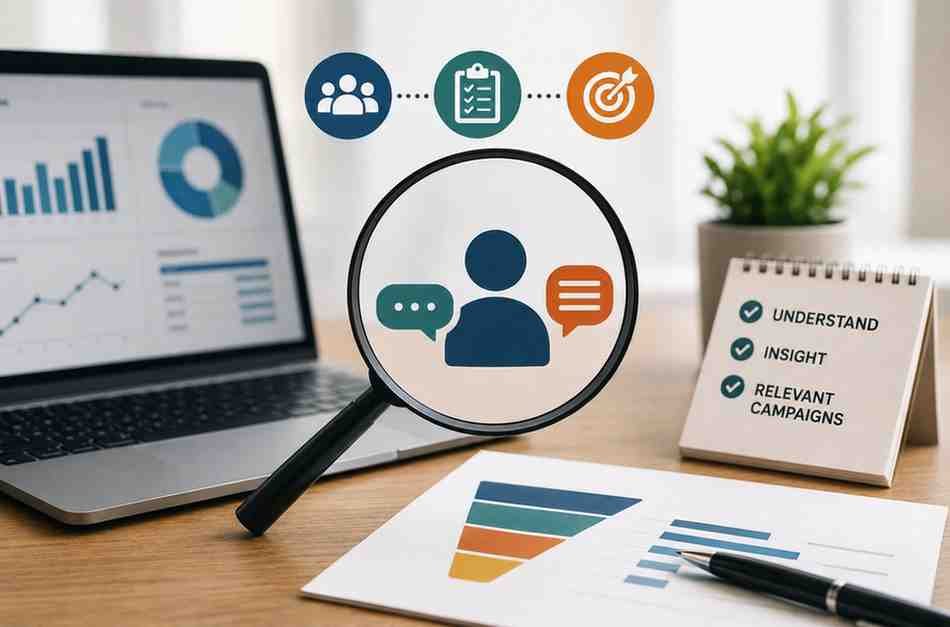
Most marketing campaigns begin with internal assumptions: what the customer wants, what they understand and which message will make them act. A buyer research system changes that. It helps marketing and sales teams collect questions, spot patterns and turn buyer language into clearer campaigns.
Make Research Part of Campaign Planning
Research should begin before the creative brief. Review sales-call notes, demo questions, website searches, support conversations, customer reviews and lost-deal reasons. A conversion-focused B2B SaaS lead-generation website can reveal where high-intent visitors need clearer proof, navigation or a reason to act.
Live settings are research environments too. A corporate event management programme can be designed around demonstrations, peer conversations and structured feedback—not simply attendance. Listen for the questions decision-makers repeat during meetings.
Capture the Words Buyers Actually Use
Internal descriptions are often more technical than customer language. Record the phrases people use when explaining a challenge, comparing alternatives or describing the result they want. These words can improve headlines, landing pages, sales decks and video scripts.
A Noida video-editing workflow can turn interviews, roundtables and customer conversations into a reusable library of clips. For purpose-led campaigns, an accessible storytelling approach for disability and inclusion NGOs is a reminder that clear communication should be respectful, easy to understand and built around real audience needs.
A practical research loop needs:
- One source of recurring buyer questions.
- One place to record objections, outcomes and exact wording.
- One campaign change tested against a clear success measure.
Test Messages Before Spending Heavily
Not every useful insight requires a major campaign. Test two or three versions of the core message: the problem, outcome, proof point or call to action. A TV9 interview-planning guide shows why a spokesperson needs a useful angle and focused talking points rather than a hard-sell script.
Digital formats can validate creative direction with flexibility. A Zee digital display campaign can reinforce one message during research, while an ABP display-advertising format can support a clear reminder in a relevant news environment. The purpose is not to chase every metric; it is to learn which message earns qualified attention.
Turn Complex Evidence Into Useful Proof
Research often reveals that buyers understand the problem but cannot see how the solution works. This is where a plant and factory animation can make a process, system or technical advantage easier to assess before a detailed meeting.
Adapt the Learning for Each Market
Patterns may be shared nationally, but language, examples and media choices should reflect regional context. A business-news sponsorship can support an authority-led conversation in Maharashtra and Goa. A Hindi media audience plan and a Colors Marathi campaign can carry the same central insight into locally relevant environments without creating unrelated messages.
For consumer brands, the research loop should continue through channel performance. A quick-commerce channel strategy helps teams see where category, price point and buying behaviour support focused expansion. The best buyer research systems do not produce more reports. They make the next campaign more relevant, credible and easier to act on.